
By now you've probably seen the New York Times headline: "How A.I. Helped One Man (And His Brother) Build a $1.8 Billion Company." It's a great headline. Sam Altman apparently thought so too. Half of LinkedIn spent a weekend sharing it as proof that we're entering a new era of company building.
They're not wrong. We unarguably are, but not in the way that story implies.
Let me tell you what was actually going on at Medvi and what it means for the founders using AI to build right now.
Matthew Gallagher did build something fast. He spent $20,000, used a stack of AI tools, and within two months had a telehealth company selling compounded GLP-1 weight loss drugs. Three hundred customers in month one, a thousand more in month two, and $401 million in verified revenue in 2025. That part technically makes it a profitable company, sure.
But Gallagher only owns the marketing layer. The doctors, the prescriptions, the pharmacy fulfilment, the clinical compliance — all of it is outsourced to CareValidate and OpenLoop Health, companies that together employ hundreds of people. When you buy from Medvi, you're interacting with infrastructure Gallagher didn't build and doesn't control.
That's not entrepreneurship. It's traffic arbitrage with a logo and a bunch of domain name redirects.
And the $1.8 billion? It's April. That number is a run-rate projection. The verified revenue is $401 million, at a 16.2% net margin, which works out to about $65 million in actual profit. Still a remarkable number but still not the story being told.
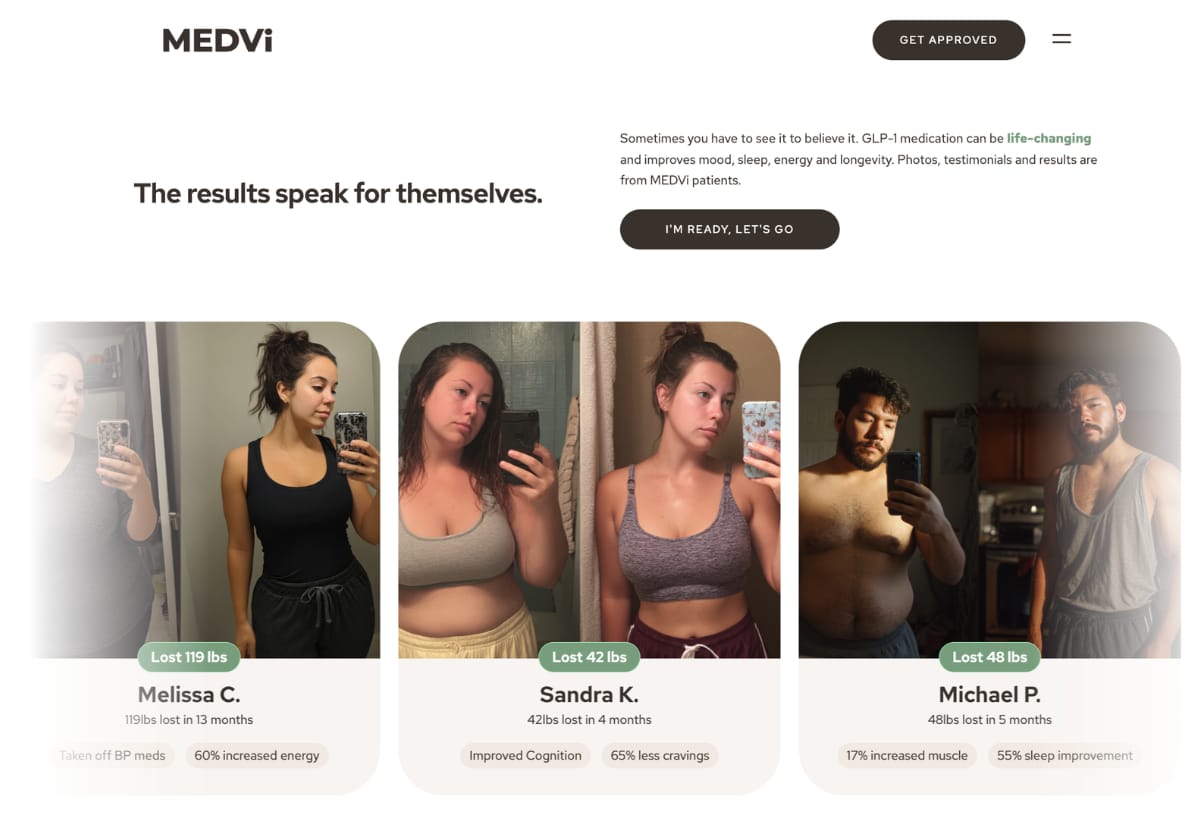
Futurism first came across Medvi through an AI-generated ad showing a mangled image of an Ozempic box — misshapen text, garbled Novo Nordisk logo — promising to "get Ozempic, Wegovy or Mounjaro at a low price." When they clicked through, the site was chock full with dramatic before-and-after photos, rapturous patient testimonials, and authoritative headshots of "incredible doctors we've partnered with." The problem: when Futurism contacted one of those doctors, he said he had no involvement with the company and demanded they "remove me from their sites."

The customer identified as "Michael P" — shown having lost 48 pounds, gained 17% increased muscle, achieved "55% sleep improvement" — was actually a random Redditor who lost a bunch of weight after giving up alcohol in the early 2010s. That’s long before GLP-1s existed as a consumer product. His weight loss photos had been featured in Bored Panda and the Daily Mail in 2017 and 2018. The only thing Medvi changed was his face, using AI.
"Sandra K's" images were stolen from a Newsweek article published in 2021. "Melissa C's" photos had been floating around the internet for nearly a decade. Medvi took real people who had lost real weight for unrelated reasons, swapped their faces with AI, gave them new names, and presented them as Medvi patients.
The site also featured a scrolling ticker of media logos — Bloomberg, Fortune, the NYT — insinuating broad press coverage. When Futurism checked, almost none of those publications had actually covered Medvi. The only item that aligned with their claims was a single Forbes affiliate listicle with a disclaimer that says "we earn a commission from the offers on this page."
After Futurism's initial investigation ran, Gallagher eventually hired his brother and claimed to have "fixed some shortcuts." The NYT echoed this framing. "Shortcut" is doing a lot of work in that sentence. As Futurism noted, Ctrl+F is a shortcut. Hawking drugs online by claiming nonexistent affiliations with doctors and deepfaking photos of strangers is fraud.
And Medvi didn't really stop. As recently as last month — nearly a year after the NYT said they'd cleaned up — an archived version of Medvi.org was again showing before-and-after transformation photos with the same names: Melissa C, Sandra K, Michael P. In the new versions, some images bore tell-tale AI generation artefacts. Sandra's fingers are melted into her smartphone. Another customer, "Helen K," appears to have no fingernails on one hand.
"The results speak for themselves," the site reads. "Sometimes you have to see it to believe it."
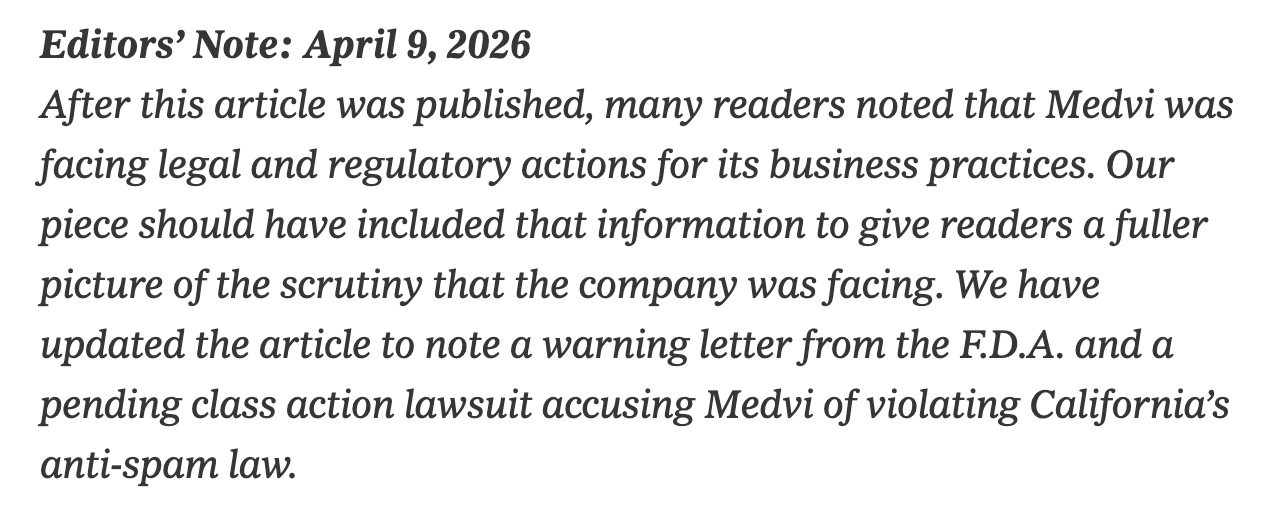
The FDA sent Medvi a warning letter in February 2026 — six weeks before the NYT profile ran. The letter flagged multiple compliance failures, including Medvi's practice of branding GLP-1 vials and pill bottles with "MEDVI" splashed across them, which the regulator said was misleading because it suggested Medvi was the compounder of the drugs, "when in fact it is not." The FDA also warned that Medvi's site had positioned unapproved compounds as "FDA-approved or otherwise evaluated for safety and effectiveness when they have not."
There is also a RICO case — a Racketeer Influenced and Corrupt Organizations Act lawsuit — accusing Medvi's partner OpenLoop of selling a compounded weight loss pill with "no demonstrated mechanism of absorption or efficacy."
The FDA's warning included this line: "Failure to adequately address any violations may result in legal action without further notice, including, without limitation, seizure and injunction."
BBB rating: F. Trustpilot: 1.2 out of 5. A class action lawsuit filed in late 2025. OpenLoop, the company handling Medvi's entire medical infrastructure, disclosed a data breach in January 2026 that exposed 1.6 million patient records.
When Futurism reached out to Medvi for comment, the company didn't respond. Shortly afterward, a large number of the fake doctor accounts promoting Medvi across social platforms were deleted.
Gallagher's response on X was to complain that critics are "the most low t guys" and "the Karens of the internet."
Does Gallagher care?
He has no infrastructure. No employees. No proprietary technology. No brand equity worth protecting. If regulators catch up — and the FDA has already determined that the semaglutide shortage that made compounding legal is over, meaning the legal basis for Medvi's entire product line is narrowing — he walks away. He took $65 million in profit out of a hot pharmaceutical vertical using AI as a distribution engine, and the people holding the bag will be patients who trusted a deepfaked doctor's face in a Facebook ad.
This isn't a story about AI going wrong. AI didn't make any of these decisions. A person did.
But AI made those decisions dramatically cheaper and faster to execute at scale. The cost of generating fake credibility — fake patients, fake doctors, fake press coverage — has collapsed.
The incentives to hop on a health trend, manufacture synthetic authority, and extract cash before the regulators arrive have never been higher.
As Dr. Jonathan Slotkin, a neurosurgeon who commented on the story, put it: the Medvi profile was "a transcript of a Silicon Valley fever dream" and "a byproduct of regulatory lag and consumer desperation."
Tactics that prioritize persuasion over truth, then scaled by AI.
The role of the founder is genuinely changing: we can build more than ever before, with fewer people. AI is compressing what used to take a team of 20 into what one founder can execute in a weekend. But the lesson isn't "move fast and skip the rest." The lesson is that when you scale something structurally unsound — legally, operationally, ethically — you're not building a business. You're scaling the problem, as one LinkedIn commenter put it.
Trust is not a nice-to-have for any organization. It is the only compounding asset that actually matters long-term. Every shortcut in marketing — every misleading claim, every synthetic testimonial, every fake authority signal — is a withdrawal from an account you haven't deposited into yet. And in health, in finance, in any space where the stakes are real, the bill comes due.
The founders worth watching are the ones making decisions for long-term brand trust, sometimes at the expense of short-term cash. They're implementing AI thoughtfully and growing more carefully. They don't have a countdown timer running on their business.
When you build fast, speed wobbles are inevitable. The question is whether your infrastructure — your ethics, your brand, your relationships with customers — can absorb them. Medvi had no infrastructure, just velocity. The moment real friction arrived (FDA, lawsuits, a data breach at a third party they couldn't control, an investigative reporter doing her job), there was nothing to hold it together.
At Cursive Lab, we believe AI should help founders both move fast and build trust, not destroy it. The tools exist to create intelligent content systems at scale, to automate, to compress the distance between idea and execution. We use them enthusiastically. But we built around the principle that speed without integrity isn't a competitive advantage. It's a liability with a delayed fuse.
The GLP-1 market is hot. AI is transforming how companies are built. Both are true, and both are exciting. One FDA crackdown and it goes to zero.
Build fast. Build real. The two are not mutually exclusive.